Blog

Similarity and substitution: Using pile sorting methods to explore economic behavior

That’s the title of a new paper I’ve co-authored with Amelia Ales and Vincenzina Caputo that has been accepted for publication in the Journal of the Agricultural and Applied Economics Association.

It has long been conjectured in economics that goods that are more similar will be stronger substitutes, but there is surprisingly scant evidence for this assertion.

To explore this issue, we turn to a research method called “pile sorting.” Pile sorting, also known as card sorting, is a method long used in qualitative social sciences, but it is largely unknown or unused by economists. The method, in use for over 50 years, entails asking people to sort items or concepts into piles or groups according to their similarities or dissimilarities. Responses are used to identify the structure of the cognitive relationships between items through cluster analysis and multidimensional scaling.

In this new paper, we explore whether perceptions of similarity or dissimilarity can help explain why consumers treat products as utility substitutes or complements. We also introduce an approach to modeling pile-sorting data that avoids downsides of common analytic techniques used in previous work.

Here’s a figure showing the analysis of the pile sort data for foods purchased in a grocery setting. People tend to rate the plant-based (PB) meats as similar to each other and very different from bananas, strawberries and apples.
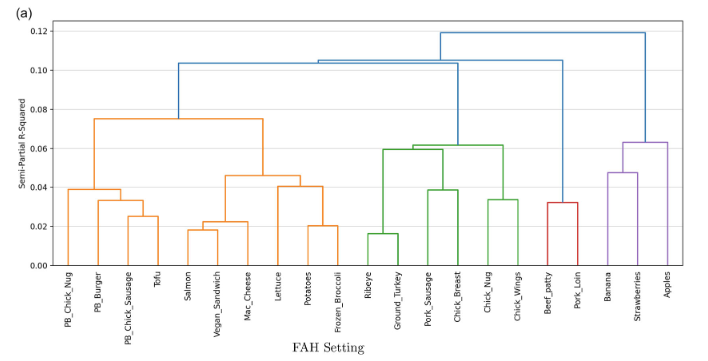
Are products perceived as more similar stronger demand substitutes? No, not necessarily. In fact, in a grocery setting, foods that are perceived as more similar are more likely to be demand complements (i.e., purchased together)
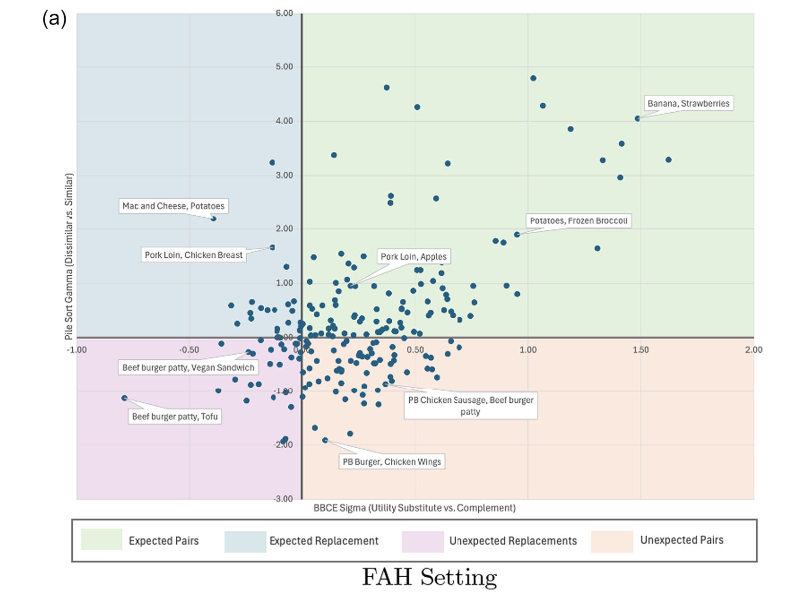
We find the opposite in a restaurant setting.

There’s a lot more in the paper including a discussion of implications for food marketing.

Global adoption of porcine reproductive and respiratory syndrome–resistant pigs will have significant economic and market impacts

That’s the title of a new article I’ve published in the American Journal of Veterinary Research.

A couple months ago, the FDA approved the use of genetic engineering to gene edit pigs to make them resistant to a disease that has ravaged the industry for decades: porcine reproductive and respiratory syndrome (PRRS). Pork producers have a number of key questions and concerns about the new technology. One fear is that the technology will “flood the market” with pork and depress prices. Another concern is that consumers will reject the new technology, resulting in lower consumer willingness-to-pay for pork or trade barriers placed on countries that adopt. This paper addresses both concerns.

I constructed an economic model to calculate the potential economic impacts of the release of PRRS-resistant pigs using data on PRRS-prevalence rates and data pigs-per-sow-per-year and mortality rates of pigs in different PRRS health statuses, provided by the Pig Improvement Company (PIC) which is commercializing the PRRS-resistant pig. More specifically, a model linking hog supply to consumer pork demand in 6 global regions, Canada, China, Japan, Mexico, the US, and the rest of the world, was constructed and parametrized using pork production and trade statistics, published supply and demand elasticities, PRRS prevalence rates, and productivity metrics by PRRS health status. The model projects changes in pork prices, production, trade, and producer profits in each country. I model a scenario in which global adoption of PRRS-resistant pigs increases over a 10 year period, with PRRS-resistant pigs ultimately reaching 70% of the swine herd in adopting countries by the 10th year.

Consistent with many producers’ concerns, I find that adoption of PRRS-resistant pigs is projected to increase pork production and reduce pork prices. However, it is also the case that the increase in pork productivity and the concomitant reduction in marginal costs of pork production are sufficient to increase pork producer profitability despite lower prices. The new technology allows producers to sell more pork at a higher net margin. Net margins rise because although pork prices fall, marginal costs fall even more.

The results also suggest that although demand reduction and trade barriers can offset some of the benefits of the technology, it all depends on the magnitudes. For example, even in an extreme scenario where retail consumers’ willingness to pay for pork from locations adopting PRRS-resistant pigs falls by 10% in every location after initial adoption (i.e., before any productivity gains are fully realized), the demand reduction initially has a detrimental effect on profitability in most locations up until about year 5, when the beneficial productivity effects of additional adoption of PRRS-resistant pigs begins to outpace the effects of the 10% reduction in willingness to pay.

From the abstract:

In the baseline scenario (70% adoption over 12 years), assuming no change in pork demand or additional cost of swine genetics, the marginal cost of production declines and pork prices fall while pork production increases in adopting countries by 11% in China to 7% in the US and Canada, and pork production falls in nonadopting countries. In the 15th year after initial adoption, profits for pork producers increase, ranging from $33/head in China to $15/head in Canada relative to preadoption baseline. Producers in the rest of the world, who are assumed not to adopt, are less profitable.

There is a lot more in the paper, including discussions on additional benefits, risks, and costs of the technology.


Food Fight

I was excited to see that my colleague, Richard Sexton, a Distinguished Professor at UC Davis, has a new book hitting the shelves next month: Food Fight: Misguided Policies, Supply Challenges, and the Impending Struggle to Feed a Hungry World. Richard is one of the most respected agricultural economists in the world, and has consistently produced some of the most interesting and impactful work in the area of agricultural market structure and market power. His new book is well worth a read, and even where you disagree with is assessment on certain food policies, you’ll benefit from engaging with is arguments. Here is the publisher’s description:

Society’s most basic challenge is arguably to produce and distribute enough food for its citizens. In 2023, 733 million people faced hunger and 2.3 billion were moderately or severely food insecure. Feeding a growing world population is becoming more difficult in the face of climate change, pest resistance to traditional treatments, and misguided government policies that limit how much food ends up on our plates. Policies to support biofuels, organic agriculture, local foods, and small farms and to oppose genetically modified foods all reduce food production on existing land. This leads to higher food prices, increased carbon emissions, and less natural habitat as cropland expands. Food Fight documents the challenges to adequately feeding the world in the twenty-first century and illustrates the ways in which contemporary food policies in the United States, Europe, and beyond imperil food security. Richard J. Sexton provides a window into the world of modern agriculture and food supply chains. He separates the wheat from the chaff to distinguish policies that will limit, or expand, the global food supply, and he explains how we can construct a food system that forestalls future hunger and environmental degradation..

Animal Welfare as a Field of Economics

Tyler Cowen recently posted a good question: Why isn’t there an economics of animal welfare field. As someone who has conducted research on this topic for more than a decade, I found the two sentences in Cowen’s post a bit amusing:

I do understand there is plenty about animal welfare in ag econ journals and departments, but somehow the way the world is tiered that just doesn’t count. Yes that is unfair, but the point remains that this subfield remains an underexploited intellectual profit opportunity.

My sense is that he means this work doesn’t “count” in the academic status game. Maybe so, but I can assure you that the work agricultural economists have done on the issue has “counted” in the real world of policy, law, farming/ranching, and agribusiness.

If you’re curious about this topic and want an intro to the topic, I can offer some of my co-authored work (mostly led by my colleague Bailey Norwood who suggested we get into this area more than a decade ago).

We have published many, many more papers on this topic, but the above gives a good sense of the theoretical and empirical contributions that currently exist. And, of course other economists such as Dan Sumner, Nicolas Treich, Glynn Tonsor, John Bovay have made many excellent contributions as well.

P.S. While not often considered a book on “animal welfare,” I’ve long enjoyed this 1995 book by Kagel, Battalio, and Green entitled Economic Choice Theory: An Experimental Analysis of Animal Behavior

A textbook on Food Economics

I had the pleasure to read an early release version of the new textbook: Food Economics: Agriculture, Nutrition, and Health by Will Masters and Amelia Finaret. A description is below.

Food Economics and its accompanying online resources are designed for advanced undergraduate or introductory graduate courses in agriculture, food, and nutrition policy. The book covers the standard diagrams taught in principles-level courses, with concrete examples and practical insights regarding food production, consumption, and trade. Online resources include data sources, and course materials, including slides, exercises, exams, and answer keys.

You can download the book here. The course materials are here.